


Offset printing is the most widely used printing technology today, commonly applied to labels, packaging, catalogs, brochures, paper boxes, books, and commercial prints in large quantities. To ensure an effective printing process, minimize errors, and optimize costs, both businesses and designers need to understand key technical terms in the printing industry.
This article provides a detailed explanation of the most important terms in offset printing: Proofing, Imposition, Film Output, Trapping, Printing Plate, Register Adjustment (Spot Varnish Printing), AB Printing, Self-Imposed Printing, and Gripper Margin.
Proofing – Color Approval Print
Proofing is a sample print used to check the color accuracy of a design before mass production. It serves as the color reference standard for the entire offset printing process.

Key features of proofing:
Color reproduction closely matches offset printing (90–95%).
High resolution and accurate color gradients.
Used for customer approval before printing.
Important note:
Fast printing or color laser printing must not be used for color approval, as they do not represent true offset colors.
Imposition – Arranging Layouts for Optimal Printing
Imposition is the process of arranging design files on a printing sheet to:
Fit the paper size,
Match the selected printing method (AB or Self-Imposed),
Optimize material usage and reduce waste.
Important factors in imposition:
Paper size and orientation
Gripper margin
Trimming allowance
Registration marks, die-cut marks
Proper layout to determine AB or Self-Imposed printing
A well-executed imposition helps reduce printing costs and ensures accurate final trimming.
Film Output
Film output refers to producing separate film sheets for each CMYK color after imposition.
Benefits of film output:
Can be stored for future reprints
Allows checking of color registration before plate making
Ensures precision when creating printing plates
Each color (C – M – Y – K) corresponds to one film sheet. After inspection, films are sent to the plate-making department.
Trapping – Overlapping and Color Compensation
Trapping is a technique used to prevent white gaps between colors caused by slight misregistration during printing. It works by slightly overlapping adjacent colors.
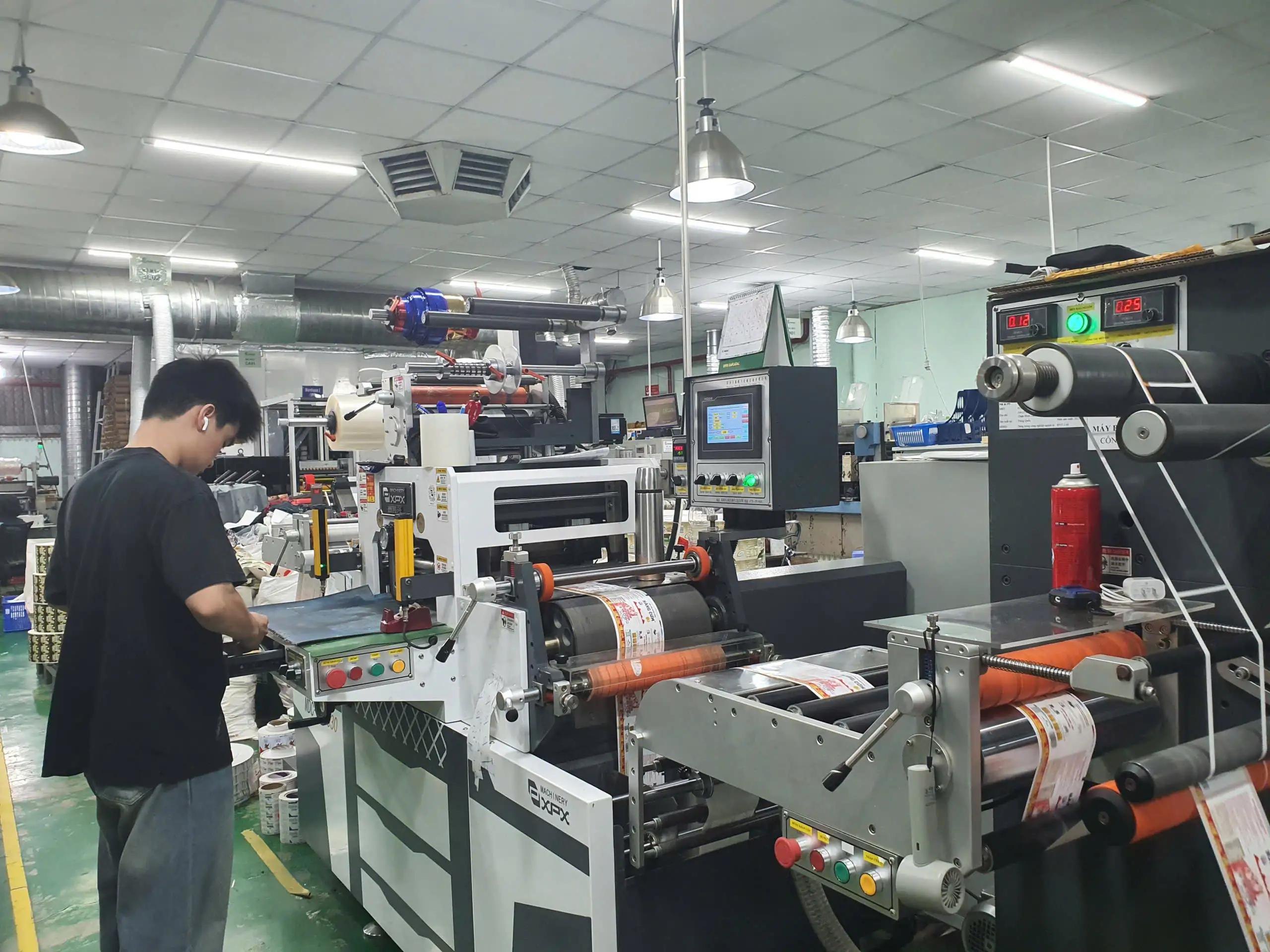
Common trapping specifications:
Coated paper: approx. 175 lpi
Uncoated paper: approx. 150 lpi
Screen printing: 80–100 lpi
CTP technology: up to 300 dpi
Proper trapping ensures solid, seamless printed results.
Printing Plate – The Core of Offset Printing
A printing plate (usually aluminum) carries the image to be printed.
Characteristics:
One plate per CMYK color
Plates are created through film exposure or CTP technology
Loaded onto the printing press for color separation printing
The quality of the plate directly affects the sharpness and consistency of the final output.
Register Adjustment (Spot Varnish Printing / Make-Ready)
In offset printing, this process is often called “register adjustment” or “make-ready”, commonly referred to in Vietnam as “in vỗ bài”.
This step involves:
Aligning (registering) all CMYK plates precisely
Checking color density, sharpness, and consistency
Adjusting ink and water balance
Matching final output to the approved proof
It determines the accuracy and quality of the finished print.
AB Printing – Two-Side Printing with Different Content
AB printing is used when the two sides of a sheet have completely different content.
Process:
Print side A
Replace all printing plates
Print side B
Perform make-ready again
Disadvantages:
Requires two sets of plates
Higher paper waste
Longer setup time
Therefore, AB printing is more expensive than Self-Imposed printing.
Self-Imposed Printing – Cost-Effective Double-Sided Printing
Self-Imposed printing is used when both sides of the sheet can be printed using the same set of plates.
Advantages:
Only one set of films/plates needed
Only one make-ready session
Less paper waste
Lower printing costs
Suitable for labels, packaging, cards, or designs with mirrored or identical layouts.
Gripper Margin – Non-Printable Paper Area
The gripper margin is the area of the sheet held by the press grippers to feed the paper through the printing machine.
Features:
This area cannot be printed
Typically 1–2 cm depending on the machine
Must be considered during design and imposition
Ignoring the gripper margin can result in lost or cut-off content.
Conclusion
Understanding offset printing terms helps businesses and designers:
Communicate more effectively with printing suppliers
Avoid technical issues that lead to color or layout errors
Control production quality more accurately
Optimize printing time and cost
Vietlabel is always ready to support your business with professional printing and labeling solutions that meet the highest quality standards.
VIETLABEL MANUFACTURING & TRADING JOINT STOCK COMPANY
Mobile (M): (+84) 086 896 8089
Email (E): thien@vietlabel.com.vn
Address (F): 266/6 Le Thi Rieng Street, Thoi An Ward, Ho Chi Minh City, Vietnam
Website (W): vietlabel.com.vn – vietlabel.vn